


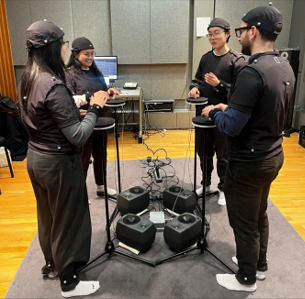
Description:
Ensemble music making requires intricate temporal coordination of movements, to come into synchrony as a group. Successful synchronization not only leads to pleasing musical outcomes, but also promotes powerful socio-emotional effects. In the proposed project, we investigate the combined use of computational modelling and adaptive virtual agents to gain deeper insights into the control principles of human temporal synchronisation. By using mathematical tools and concepts of dynamical systems theory, we model ensembles of human drummers as a system of coupled oscillators, to better understand their temporal synchronisation dynamics. We thereby advance current state-of-the-art mathematical models to deal with larger ensembles and higher rhythmical complexity. Based on this research, and embedded within a fundamental art and science approach, we take our models as the basis for the development of adaptive virtual agents, which are graphically represented as human-like three-dimensional holograms through mixed-reality displays. Adaptive agents will be employed as a novel methodological tool to evaluate and optimise models further, within real-time musical interactions with human drummers. Importantly, we explore adaptive artificial agents, and their virtual embodiment, in their potential to develop novel musical performance practices. With this, we aim to contribute fundamentally to innovation in the cultural and creative sector in the digital era.
IDMIL Participants:
External Participants:
- Dr. Caroline Palmer (McGill)
- Dr. Pieter-Jan Maes (Ghent University)
- Dr. Bart Moens (Ghent University)
- Catherine Lin (McGill)
- Davide Lionetti (Ghent University)
Research Areas:
Publications:
- Bavo Van Kerrebroeck, Marcelo M. Wanderley, Alexander P. Demos, Caroline Palmer (2024-07-15). Virtual Partners Improve Synchronization in Human-Machine Trios. In CogSci 2024 - Dynamics of Cognition. 46th Annual Meeting.. Rotterdam, NL.
- Bavo Van Kerrebroeck, Marcelo M. Wanderley, Alexander P. Demos, Caroline Palmer (2025-02-03). Virtual Partners Improve Synchronization in Human-Machine Trios. In Cognitive Science.